
Founders & Owners
Most of your net worth reports to you on Monday morning.
When you have a business, its concentrated wealth is the defining fact of your financial life, and it doesn't wait for a transaction to start having consequences. As a multi-family office, Strategic Wealth Partners acts as your family’s CFO and CIO—coordinating the operating company and family balance sheet as one financial system.
Request a Conversation Request a Meeting
 Start wherever it's actually pinching.
Relationships often just start with one problem that's gotten loud enough to do something about.
-

A tax bill that grows every year and has never been planned around, only paid.
-

A valuation you don't believe: someone's number, maybe from an approach you never asked for, that you either think is unrealistically high or suspect is way too low.
-

Too much of the company still running through you. You know it. You've known it for a while.
-

One child in the business and two who aren't, and no decision made about what's fair.
-

Multiple professional advisors, multiple opinions, and you in the middle deciding which one wins.
Any of these is a fine place to start, and starting there is the point. We'll work the problem in front of you. We'll also tell you what it's attached to, because in a business-owning family, it's likely attached to more than one thing.
Request a ConversationOptions have expiration dates.
The most expensive mistake in owner planning is often a good decision made too late.
-

Ownership and transfer structures work best when they’re in place before a liquidity event or major increase in value. Wait too long, and both the economics and the available options can change.
-

Owner dependence and management depth take time to fix. If the business still depends heavily on you, key employees, or a concentrated customer base, that can limit transferability and weaken your position with a successor or buyer.
-

Tax and transaction planning run on their own calendars. Many of the most valuable moves need to happen well before a sale, while buyers are increasingly disciplined about diligence, risk, and terms.
Proactive Tax Strategy
The operating side matters, too. And the market has gotten less forgiving.
Buyers are more selective and more disciplined than they were a decade ago. Diligence goes deeper, and the distance between a prepared company and an unprepared one shows up in the terms, not only the price.
Our Enterprise Operating System focuses on the operating discipline, management depth, and transferability that help make a business more valuable and better positioned for whatever comes next.
None of this requires you to be actively in the market to sell. It requires you to keep your options open while there's still time to shape the eventual outcome.
Read the Enterprise Operating System white paper Book a 30-minute session with an Enterprise Operating System specialistThe number everyone talks about isn’t the number that matters.
Ask what the company is worth and you’ll get a price. Ask what the family actually keeps—and what that capital has to do next—and the answer gets more complicated.
Price is only one variable.
Two owners can sell at the same headline price and end up in very different positions.
And if the plan is succession rather than sale, the same variables still matter—just on a longer clock.
01Structure.
Cash, stock, rollover equity, earnouts, and seller notes all carry different risks and tax consequences.
02Taxes and timing.
When the deal closes, how gains are characterized, and what planning was in place beforehand can materially change the result.
03Liquidity and control.
What is accessible, what stays tied up, and what obligations remain after closing all shape the family’s actual position.
04What comes next.
The capital may need to fund retirement, support the family, preserve wealth across generations, or finance another venture. Those goals affect how the proceeds should be structured.
When a deal gets real, it’s more than a business decision.
It becomes a tax decision, an estate decision, a risk decision and a liquidity decision, all at once and faster than most families are ready for.
Here’s what we do:
- 01
Help you identify and evaluate bankers, including what each one is optimizing for, which is not always what you're optimizing for.
- 02
Pressure-test the structures on the table against the family outcome rather than the headline.
- 03
Work alongside transaction counsel and accountants so the tax, entity and estate work is sequenced deliberately instead of discovered at diligence.
- 04
Model what each structure leaves you holding, spendable, and after tax.
- 05
Have the post-close plan built before the wire lands, not after.
We're not an investment bank. We don't run the sale process, and we don't source your buyer. The bankers run the deal. We stay in the family CFO/CIO role, making sure the transaction, tax, liquidity, estate and investment decisions work toward a good family outcome.
Business ownership may change. The family balance sheet still needs someone in charge.
For years, the company is the balance sheet. Then ownership changes—and so does the financial perspective.
When the equity converts
A sale, recapitalization, or partial liquidity event can turn one concentrated asset into cash, rollover equity, trusts, marketable securities, private investments, real estate, and new ventures.
That isn’t simpler. It’s a different kind of complicated, and it often arrives all at once.
When it doesn’t convert
Passing the business to a child, partner, or management team can look simpler. Often it’s harder because succession doesn’t automatically create liquidity.
The estate can still be taxed on an asset nobody intends to sell. The family may need cash to pay a tax bill tied to equity it plans to keep.
Fair and equal can stop meaning the same thing. One child may run the company while others do not, creating difficult questions about ownership, liquidity, control, and inheritance.
None of that is an argument for selling. It’s an argument for putting the right structures in place—funding, entity design, liquidity planning, and transition terms—years before the handoff.
The owners who navigate these changes best usually have the relationship in place before the change happens.
One relationship across the business and the family.
Strategic Wealth Partners is a multi-family office. For a business-owning family, that means we act as the family's CFO and CIO, holding one governing view across the operating company and the family balance sheet and staying accountable for how decisions fit together.

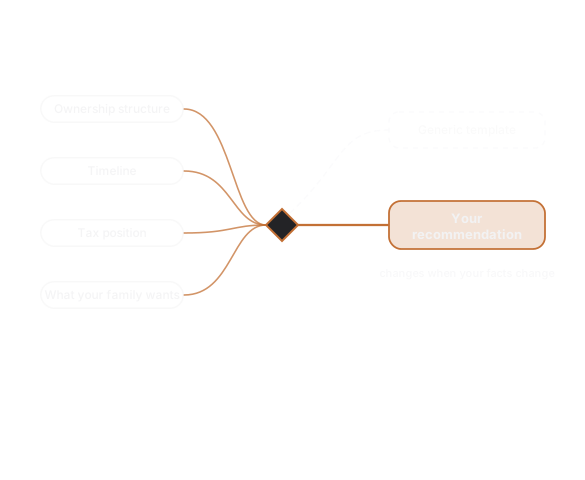

Three things an MFO changes:
The company and the family's finances stop being two conversations with different people in the room. We hold the whole picture—enterprise value, tax position, estate structures, risk, concentration, investments, liquidity—and we own the question about what fits and how.
You'll know what we think you should do, why we think it, and which specific facts about your company and your situation are driving it. Change the facts—the ownership structure, the timeline, the tax position, what your family wants—and the recommendation changes with them. That's the difference between advice that's yours and a template with your name at the top.
Bankers arrive and leave. Consultants finish engagements and invoice. Transaction counsel closes the file. We're the relationship that's still holding the picture after some specialists rotate out and some stay on, which matters most in the years when the most is changing. One family balance sheet. One coordinated strategy.
The people behind the coordination. Depth in every seat.
Investments, tax and planning, business value, transaction coordination, advisory—senior people for each. Which is why the conflict between what's best for the portfolio and what's best for the tax year gets settled here, relative to your whole picture, instead of reaching your desk as two recommendations that contradict each other.

As Chief Investment Officer, Nate is the architect for SWP’s overall investment strategy. He oversees the firm’s investment committee, research... Read more
Senior Wealth Advisor

As Senior Wealth Advisor with Strategic Wealth Partners, Tony manages two highly important roles. He draws from his diverse array... Read more

There’s nothing Strategic Wealth Partners CEO Mark Tepper loves more in this world than winning. What constitutes a win for... Read more

As Chief Investment Strategist, Peter manages a nationwide roster of SWP’s largest clients. He is particularly skilled at creating custom... Read more
Senior Wealth Advisor

Kristin Kelly brings more than 23 years of specialized tax experience to Strategic Wealth Partners, where she serves as Director... Read more

With over 25 years of experience in the industry, Matt brings a depth of knowledge and insight to his role... Read more
Chief Compliance Officer and
Senior Wealth Advisor

As the Chief Financial Officer at Strategic Wealth Partners, Steve brings over 8 years of expertise. He spearheads the corporate... Read more

David Abate deeply values the trust clients place in him. As a CERTIFIED FINANCIAL PLANNER® professional, David designs comprehensive financial... Read more

Rick Eicheldinger, Director of Financial Planning at Strategic Wealth Partners, brings over a decade of experience in the financial planning... Read more

Derek Gabrielsen delights in forging personal relationships with clients and putting them at ease about their financial future. Derek knows... Read more

With 30 years of experience as a CERTIFIED FINANCIAL PLANNER® (CFP®), Brian Martin has established himself as a trusted advisor... Read more

As Senior Wealth Advisor and Director of Sports & Entertainment, Gabe leads SWP's work with athletes and entertainers. He serves... Read more

Anthony leads client relationships and retirement planning at Strategic Wealth Partners, LTD., an SEC-registered investment adviser. He is known for... Read more

Robert Lambert is Strategic Wealth Partners’ triple threat in investments. Along with being a portfolio manager and trader for SWP’s... Read more
Research Analyst

With more than 14 years of experience in the financial services industry, Nick brings a strong background in sales and... Read more

Sam Petitjean brings an energetic, client-first approach to his role as an Associate Wealth Advisor, combining a strong foundation in... Read more

Cole Frischman serves as an Associate Wealth Advisor at Strategic Wealth Partners, where he supports both existing and prospective clients... Read more

Jack Root joined Strategic Wealth Partners as an Associate Financial Advisor after graduating from John Carroll University, where he earned... Read more

Lisa Meluch brings over a decade of dedication to Strategic Wealth Partners, where she has been an integral part of... Read more

Jessica Gross serves as a Senior Operations Analyst at Strategic Wealth Partners, where she supports the firm’s account maintenance and... Read more

Lincoln Nye serves as an Investment Associate at Strategic Wealth Partners, where he supports the firm's investment team through manager... Read more

David Kuhr serves as Compliance Consultant for Strategic Wealth Partners, where he works closely with the firm's compliance department and... Read more

Joseph brings creativity, versatility, and a passion for storytelling to his role as Media and Marketing Coordinator at Strategic Wealth... Read more

Jeremy Owen serves as Operations Concierge at Strategic Wealth Partners, where he supports the team behind the scenes to help... Read more

Brittany Halsey serves as Office Manager at Strategic Wealth Partners, where she plays a pivotal role in shaping the firm’s... Read more
Built by an owner, for owners. Mark Tepper founded SWP in 2003. Four books for business owners, a seat in the same YPO and EO rooms our clients sit in, and enough exposure to what today's buyers actually reward to tell you where you'd be discounted—before you engage a banker, while there's still time to fix it.
Engineering Your Exit is our flagship authority and acquisition platform for founders and owners facing questions around business value, readiness, transition, tax, and liquidity.
"Ambition alone isn't a strategy."
—Engineering Your Exit, Mark Tepper

Let’s start with the problem you actually have.
Not a pitch, not a plan presentation. A conversation and straight answers about your company, your ownership, and what you intend to do with both—a sale, a handoff, or another ten years of running it.
Request a Conversation